Chemists started making colors that nature never offered: Prussian blue by accident, then cobalt, chrome, cadmium and synthetic ultramarine. Sold ready-made in the new collapsible tin tube, they gave the Impressionists their brightness.
Discovered by accident in Berlin by a color maker trying to make a red. The first modern synthetic pigment: deep, cheap and enormously strong. By the 1830s it had reached Japan, where it gave Hokusai's prints their blues.
Found in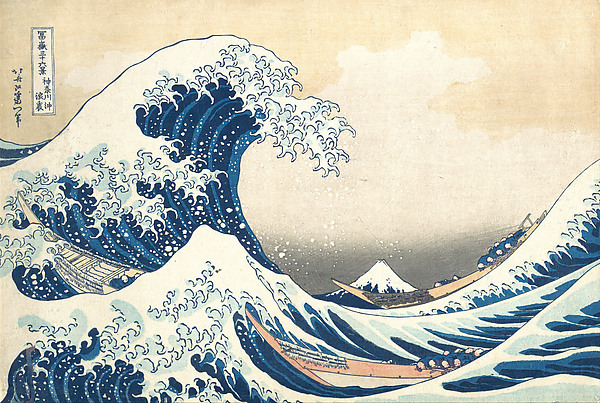 The Great Wave off Kanagawa, Hokusai
One of the first cobalt colors, a pale, weak green that was always expensive. It's still made, but mainly for its gentle, cool tint.
Invented in Paris by Louis Jacques Thénard as a stable replacement for smalt and expensive ultramarine. A clean, cool blue that became an Impressionist favorite for skies and shadows.
Found in The Gare St-Lazare, Monet
 A Wheatfield, with Cypresses, Van Gogh
Chrome yellow
1810sNo longer madeLead chromate: a brilliant, cheap yellow, and the yellow of Van Gogh's sunflowers. Some kinds darken toward brown in light, which scientists have measured happening in his paintings.
Found inA Wheatfield, with Cypresses, Van Gogh Sunflowers, Van Gogh
Emerald green
1814No longer madeA vivid copper arsenic green, also sold as Paris or Schweinfurt green, and also used as a rat poison. Monet, Cézanne and Van Gogh all used it. Tubes called emerald green today are hues made from safer pigments.
It contains arsenic and is no longer made for artists.
Found inThe Gare St-Lazare, MonetA Wheatfield, with Cypresses, Van Gogh
Synthetic (French) ultramarine
1828In 1824 France offered a prize for a way to make ultramarine; Jean-Baptiste Guimet won it in 1828. Chemically the same as lapis, at a tiny fraction of the cost, it put the most precious blue on every palette.
Found inThe Gare St-Lazare, MonetA Wheatfield, with Cypresses, Van Gogh
A clean, cool, non-toxic white, first sold to artists as a watercolor in 1834 and later in oil. Van Gogh used it everywhere. Thick layers of pure zinc white can become brittle and crack over time, so many painters prefer it mixed with titanium.
Found inA Wheatfield, with Cypresses, Van Gogh
Cadmium yellow and orange
1840sCadmium was discovered in 1817, and its bright, opaque yellows were in artists' tubes by the 1840s. Munch used it in The Scream, where scientists found early cadmium yellow breaking down in damp air. Modern cadmium pigments are far more stable.
Found in The Scream, Munch
A transparent, cool, emerald-like green made from chromium, patented in Paris. Safer and steadier than emerald green, it became a staple of Monet's and Van Gogh's greens and skies.
Found inThe Gare St-Lazare, MonetA Wheatfield, with Cypresses, Van Gogh
The first stable violet pigment, delicate and expensive. Monet loved it. Early versions contained arsenic; today's are cobalt phosphate.
A cobalt and tin blue, sold to artists from 1860 under the name coeruleum. Opaque and slightly green, it's the classic sky blue, and part of Monet's blues in The Gare Saint-Lazare.
Found inThe Gare St-Lazare, Monet
Cobalt yellow: a transparent, cool yellow popular with watercolorists. It's prone to fading and darkening in oil, and most painters now use a transparent arylide or nickel azo yellow instead.
Chromium oxide green
1860sViridian's opaque cousin: a dull, sage green that is extremely permanent and covers well.
Two German chemists worked out how to make madder's colorant, alizarin, from coal tar: the first natural dye ever made in a lab. It quickly replaced madder. It fades in thin layers, and quinacridones and pyrroles now do its job better.

